
Cybersecurity is no longer only an IT responsibility. For mid-market enterprises, it is increasingly a business governance responsibility—directly connected to operational resilience, regulatory obligations, customer trust and business continuity.
The challenge is that many mid-market organizations operate with limited security teams, fragmented technologies and rapidly evolving digital environments. The objective, therefore, should not be to build an unnecessarily complex security framework, but to establish clear ownership, measurable controls and consistent governance.
From Security Tools to Security Governance
Firewalls, endpoint protection, identity controls, vulnerability assessments and email security are important, but technology alone does not constitute cybersecurity governance.
Effective governance establishes clarity around:
- Who owns cybersecurity risk?
- Which systems and information require protection?
- What security controls are mandatory?
- How are risks identified, prioritized and tracked?
- How quickly must incidents be reported and addressed?
- How is compliance demonstrated to management, customers and regulators?
This shifts cybersecurity from a collection of technical activities into a structured management discipline.
A Practical Governance Model
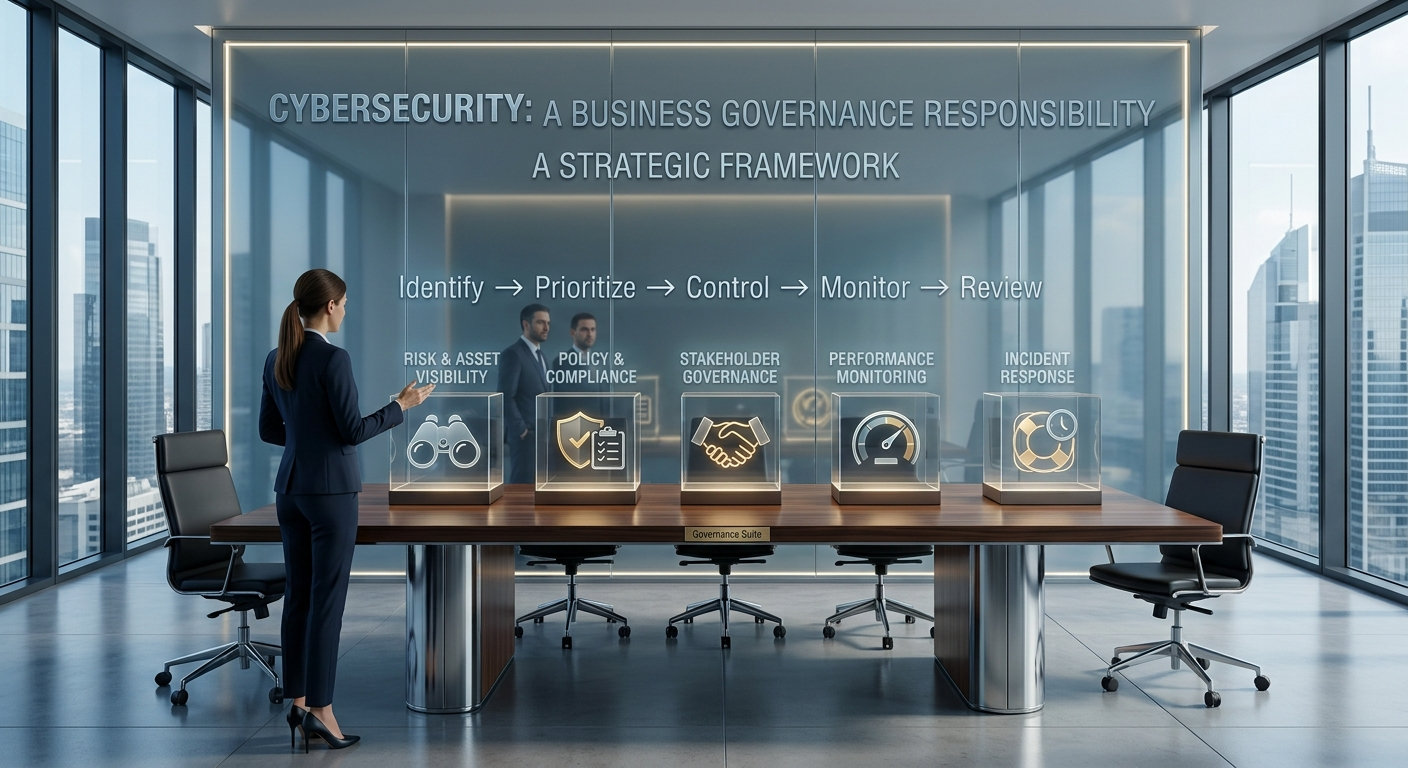
For mid-market enterprises, cybersecurity governance can be structured around five fundamental areas:
1. Risk & Asset Visibility
Maintain visibility of critical applications, infrastructure, identities, endpoints, data and third-party dependencies.
2. Policies & Control Framework
Establish practical security policies covering access management, data protection, endpoint security, email security, network security, vulnerability management and incident response.
3. Accountability & Ownership
Define responsibilities across leadership, IT, security teams, business functions and third parties. Security controls without accountable owners are difficult to sustain.
4. Monitoring & Assurance
Regularly review vulnerabilities, security events, access rights, policy compliance and control effectiveness. Governance should measure whether controls are actually operating as intended.
5. Incident Readiness & Resilience
Organizations should know how they will detect, contain, communicate and recover from a cybersecurity incident before one occurs.
Governance Does Not Mean More Complexity
A common misconception is that cybersecurity governance requires enterprise-scale teams, extensive documentation and expensive platforms.
For a mid-market organization, governance can begin with a risk-based operating model:
Identify → Prioritize → Control → Monitor → Review → Improve
The emphasis should be on protecting the organization's most critical business processes and information rather than attempting to treat every asset with the same level of security.
The Executive Perspective
Leadership should be able to answer five straightforward questions:
- What are our most critical digital assets?
- What are our primary cybersecurity risks?
- Which controls are protecting them?
- Who is accountable for those controls?
- How do we know the controls are effective?
If these questions cannot be answered with reasonable clarity, the organization may have cybersecurity technologies—but its cybersecurity governance may still be immature.
Building Cybersecurity as a Business Capability
Strong cybersecurity governance creates a connection between business objectives, technology risk and operational resilience.
For mid-market enterprises, the goal is not simply to prevent every possible threat. It is to establish a repeatable governance structure that enables the organization to understand risk, make informed decisions, demonstrate accountability and respond effectively when conditions change.
Cybersecurity maturity begins with visibility and control—but sustainable security begins with governance.
Intellicore Perspective
Intellicore Global approaches cybersecurity from a governance and business-risk perspective, helping organizations establish practical security capabilities across IAM, DLP, GRC, endpoint security, VAPT, email security, firewalls and broader IT security operations.
The objective is straightforward: make cybersecurity measurable, accountable and aligned with business priorities.